Understanding College Application Deadlines
Early Action, Early Decision, Rolling Admission, Restrictive Early Action, and ED II
If you've started researching colleges, you've probably come across terms like Early Action, Early Decision, Rolling Admission, and Restrictive Early Action. While they sound similar, each application plan comes with different deadlines, rules, and commitments. Choosing the right application strategy can improve your chances of admission, reduce stress, and sometimes even save money.
Note: See the Common App for up-to-date deadlines and specific school application options.
Early Action (EA)
What it is:
Early Action allows students to apply earlier than the regular deadline—typically in October or November—and receive an admission decision earlier, often in December or January.
Is it binding?
No. If you're accepted, you're not required to attend.
Benefits
Receive an admission decision early.
Reduce senior-year stress by having a possible acceptance before the holidays.
Compare financial aid offers from multiple colleges.
Show strong interest by applying early.
Many schools fill a significant portion of their incoming class through Early Action.
Things to Consider
Your application needs to be ready by early fall.
Senior-year grades usually won't be included.
SAT or ACT scores (if submitting) should ideally be completed by the summer or early fall of senior year.
Best for students who:
Have a strong GPA and activities by the start of senior year.
Have completed testing or are happy with their scores.
Want flexibility when making their final college decision.
Early Decision (ED)
What it is:
Early Decision is an early application option for students who have found their absolute first-choice college.
Is it binding?
Yes. If admitted, you agree to:
Withdraw all other college applications.
Attend that college.
Submit your enrollment deposit.
Benefits:
Demonstrates your highest level of interest.
Some colleges admit students at higher rates through Early Decision.
You'll receive your decision early.
Things to Consider:
You cannot compare financial aid offers from other schools before making your decision.
You should only apply ED if you are completely certain this is your first-choice school.
Best for students who:
Have researched colleges thoroughly.
Have visited campus (if possible).
Know exactly where they want to attend.
Have discussed finances with their family.
Early Decision II (ED II)
Many students don't realize there's a second round of Early Decision.
What is it?
ED II works just like Early Decision—it is still binding—but the deadline is usually in January rather than November. Students often receive decisions in February.
Why would someone choose ED II?
They discovered a better-fit college later in the fall.
They weren't admitted through an earlier Early Decision application.
They needed more time to improve test scores or finish applications.
Benefits:
Still demonstrates a high level of commitment.
Allows additional time to strengthen your application.
Can improve admission chances at some colleges.
Best for students who:
Found their first-choice school later in the process.
Need more time to prepare a stronger application.
Are comfortable making a binding commitment.
Restrictive Early Action (REA)
Restrictive Early Action (sometimes called Single-Choice Early Action) is offered by only a small number of highly selective colleges.
Like Early Action:
It is not binding.
You are not required to attend if admitted.
However, there are restrictions on where else you may apply early.
Each college has its own rules, but generally:
You may not apply Early Decision elsewhere.
You may not apply Early Action to many private colleges.
You can usually still apply to public universities with non-binding Early Action plans.
Benefits:
Receive an early decision.
Keep the freedom to compare financial aid offers.
Demonstrate strong interest in a highly selective institution.
The restrictions vary by college, so it's critical to read each school's policy carefully.
Best for students who:
Have a clear first-choice highly selective university.
Want an early decision without making a binding commitment.
Have an exceptionally strong academic profile.
Rolling Admission
Rolling Admission is the most flexible application process. Instead of waiting until one deadline, colleges review applications as they arrive. Students typically receive decisions within several weeks after submitting a complete application.
Benefits:
Apply whenever your application is ready.
Receive decisions quickly.
Reduce uncertainty early in senior year.
Many colleges:
Fill programs as applications arrive.
Award scholarships on a first-come, first-served basis.
Have limited housing availability.
Best for students who:
Want flexibility.
Need more time to complete applications.
Want an early admission decision without a binding commitment.
Which Option Is Right for You?
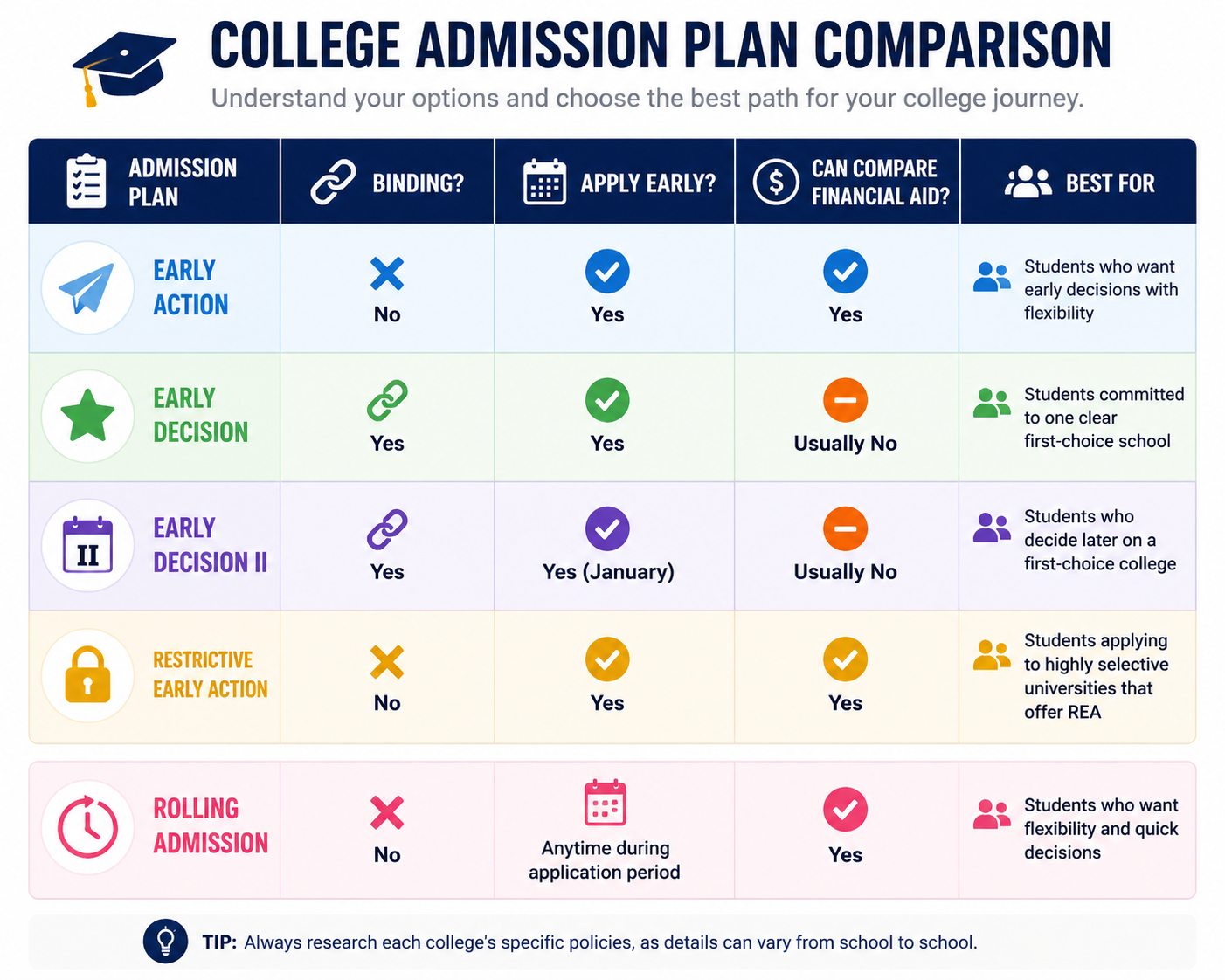
There isn't one "best" admission plan for every student. The right strategy depends on your academic preparation, college list, financial situation, and level of certainty about where you want to attend.
Remember: Applying early only helps if you're submitting your best application. A polished essay, strong activities list, and well-prepared application are far more important than rushing to meet an earlier deadline.
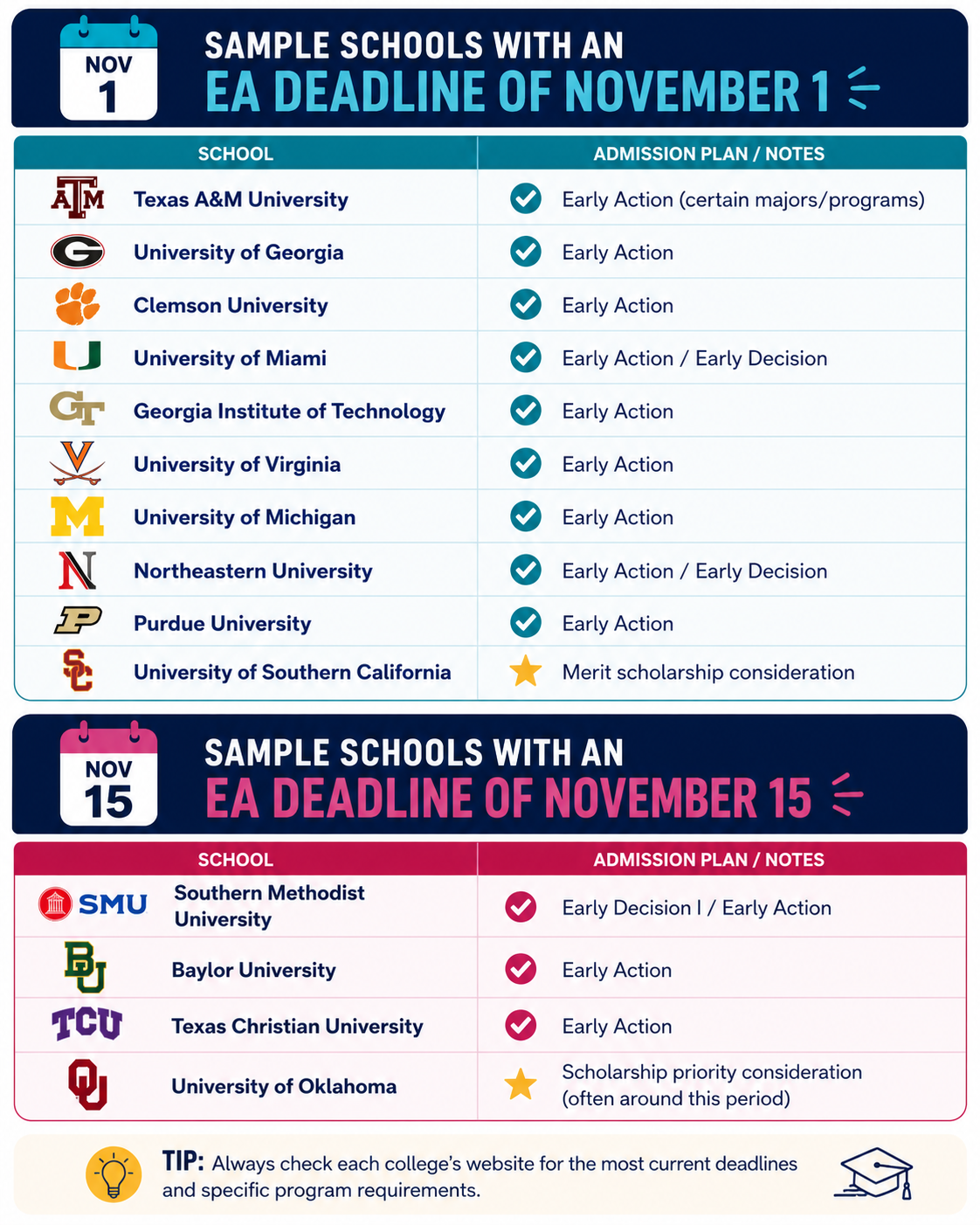
Sample Schools with an EA deadlines: