
The Complete SAT & ACT Test Prep Plan for Texas High School Students
Your AIM Roadmap
Choose Between the SAT and ACT
Understand What a Good Score Actually Means
Find Your Baseline Score
Calculate Your Study Hours
Choose Your Testing Timeline
Timeline 1: The Sophomore Head Start
Timeline 2: The Standard Junior Plan
Timeline 3: The Early-Bird Junior
Timeline 4: The Steady-Pace Plan
Grade-by-Grade Action Plan for Texas Students
Building Your Weekly Study Schedule
A Note on Texas-Specific Scheduling Conflicts
Test-Optional Policies: Do You Still Need to Test?
Best Free SAT and ACT Prep Resources
Why Texas Families Choose AIM Learning Center
Related Reading from AIM Learning Center
If you're a Texas high school student — whether you're navigating UIL season, a packed AP schedule, or just trying to figure out where to even begin — planning for the SAT or ACT can feel like one more overwhelming thing on an already full plate. At AIM Learning Center, we've helped hundreds of Texas students build smart, stress-free test prep plans that fit their lives and deliver real score gains.
This guide covers everything you need: how to choose between the SAT and ACT, what counts as a good score for your college goals, when to start studying based on your grade level, how many hours to plan for, and four proven testing timelines built for real student schedules. We've also included a free, fillable Test Prep Plan template you can download and print today.
Step 1: Choose Between the SAT and ACT
One of the first major decisions in your college-planning journey is whether to take the SAT or the ACT. It's also one of the most misunderstood. Many students assume one test is harder than the other, or that certain colleges prefer one over the other — but neither of those things is true.
Nearly every college and university in the United States, including all major Texas schools, accepts both the SAT and the ACT equally. Admissions offices do not favor one over the other. Your goal isn't to pick the "better" test — it's to pick the one where you are most likely to shine.
The SAT tends to be a better fit if you:
Prefer working carefully and methodically through fewer, more complex questions
Excel in algebra and data interpretation
Enjoy evidence-based reading and passage analysis
Do better with slightly more time per question
The ACT tends to be a better fit if you:
Are comfortable with faster-paced tests and more questions
Enjoy science reasoning and interpreting data across multiple subjects
Do well with direct, curriculum-based questions
Work quickly under time pressure
Want a dedicated Science section that plays to your strengths
A practical note on testing style and personality: if time pressure causes anxiety, the SAT's pacing may feel more manageable. If you like staying active and engaged and prefer moving through content quickly, the ACT's pace might actually work in your favor.
The best way to decide? Take both. We recommend sitting down with a full-length official SAT practice test and a full-length official ACT practice test — scored and timed — before committing to either. Compare your results using official concordance charts. Many students discover they naturally score higher on one test even when they expected the opposite. AIM Learning Center offers free diagnostic tests for both exams with an expert score review included.
Also worth knowing: you are not locked in. Many students take both exams at least once, evaluate their scores, and submit their strongest result. Colleges focus on your best performance, not how many tests you attempted.
For a deeper look at how the two exams compare in format, pacing, and section structure, read AIM's full breakdown: SAT or ACT? How to Choose the Right Test for You
Step 2: Understand What a Good Score Actually Means
Before you can build a meaningful study plan, you need a target — and that target should be grounded in the schools on your list, not in a generic number you found online.
A "good" SAT score is not the same for every student. It depends entirely on your goals, the colleges you're considering, and how your academic profile fits within each school's applicant pool.
As a general national reference point, here's how SAT scores tend to map to selectivity:
1100–1200: Solid for many state schools and less-selective universities
1300–1350: Competitive for strong public universities (UT Knoxville, UGA, Clemson, and comparable schools)
1400–1450: Competitive at top-50 universities and many business programs
1450–1500: Strong for most top-20 schools, though not a guarantee
1500–1550+: Competitive at Ivy League, Stanford, MIT level institutions
For Texas students specifically, general benchmarks at flagship schools are:
UT Austin (middle 50% SAT range: 1260–1510 / ACT: 28–34)
Please know thatMcCombs Business School and Cockrell School of Engineering look for a SAT Math score of 750+
Texas A&M (1200–1390 / ACT: 26–32)
Texas Tech (1040–1260 / ACT: 21–28)
Baylor (1180–1390 / ACT: 25–31)
TCU (1200–1410 / ACT: 26–32).
When you have a school list in hand, look up the 25th and 75th percentile SAT and ACT scores for each school — you can find these in each school's Common Data Set. Your target should be at or above the 75th percentile for your most selective school.
Submitting Your Score or Not
Here's a quick framework from AIM's college advising team: if your score falls below the 25th percentile for a school, applying test-optional (where permitted) is usually the stronger move. If you're in the 25th–75th percentile range, include it, but let the rest of your application do heavy lifting too. Above the 75th percentile? Lead with it — you're also likely in range for honors programs and merit scholarships.
For a full breakdown of score benchmarks, see AIM's dedicated guide: What Is a Good SAT Score?
Step 3: Find Your Baseline Score
Before you can map a path forward, you need a starting point. If you've already taken the PSAT, use that score as your baseline — we recommend this for most students. If not, take a full-length official practice test, timed and unprepped, using the free tests on College Board's website (SAT) or ACT.org (ACT). Either way, once you have your score, review every wrong answer and look for patterns: one subject, one question type, time pressure? That diagnostic tells you exactly where to focus.
Step 4: Calculate Your Study Hours
The number of hours you need to prepare is driven by one thing: the gap between your baseline score and your target score.
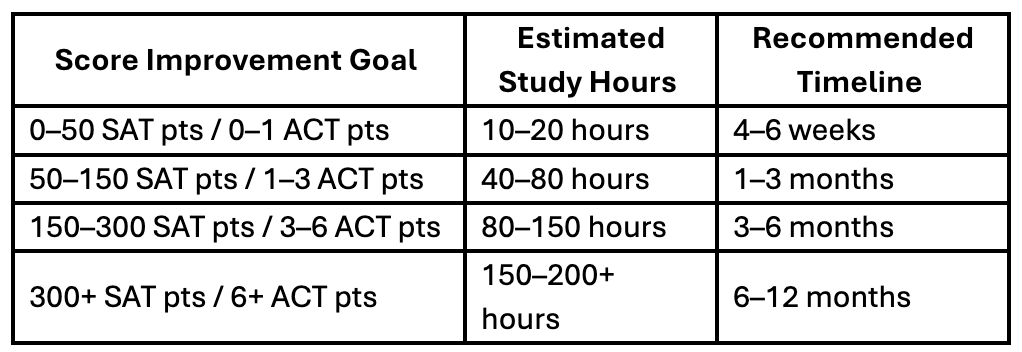
These ranges assume consistent, focused study — not passive reading or skimming prep books. Working with an AIM tutor can compress these timelines significantly by targeting your specific weak areas from the first session rather than starting from a generic curriculum.
Step 5: Choose Your Testing Timeline
Not every Texas student is in the same situation. Find the path that matches where you are right now.
Sophomore Year: The Head Start Best for students in Pre-Calculus or Algebra II who want maximum flexibility and testing off their plate before junior year intensifies.
Take the PSAT/NMSQT or PSAT 10 (free at most Texas high schools) — use it as your first diagnostic, not a performance benchmark
Decide between the SAT and ACT by spring
Begin light structured prep over the summer (2–3 sessions per week)
Take your first official SAT or ACT in August or September of junior year
Goal: testing complete by December of junior year at the latest
Junior Year: The Standard Plan Best for most Texas students — and what most Texas counselors recommend.
Use fall semester as your dedicated prep period (3–5 hours per week)
Take your first official attempt in spring — March for the SAT, February or April for the ACT
If your school offers SAT School Day, that counts as your first official attempt
Plan for at least one retake in spring or early summer if needed
Goal: hit your target score before senior year begins
Junior Year: The Early-Bird Plan Best for students with packed spring schedules — UIL competitions, spring sports, or heavy AP loads.
Do intensive prep over the summer before junior year (2 sessions per week)
Take your first official attempt in December of junior year
Use February/April (ACT) or March (SAT) as backup retake dates if needed
Goal: testing complete before spring semester of junior year begins
Junior Year: The Steady-Pace Plan Best for students with larger score gaps, IEP/504 accommodations, or those who retain material best through slow, consistent repetition.
Begin weekly prep sessions in September or October of junior year
Take your first official attempt in March (SAT) or April (ACT)
Retake in summer or early senior fall if needed
Hard deadline: October or November of senior year for most Texas applications
Senior Year: Retakes Only Senior year should not be where you start from scratch — it's for finishing what junior year began.
Acceptable test dates: August, October, and November
December is a last resort and may not reach schools before early action/decision deadlines
UT Austin's priority deadline is November 1; Texas A&M uses rolling admissions
If applying Early Action or Early Decision anywhere, have scores finalized by October
Building Your Weekly Study Schedule
The most effective SAT and ACT prep is not built on marathon sessions — it's built on consistent, focused weekly habits. Here's how to structure your time based on how far out your test date is:
6+ months out: Two to three sessions per week, 45–60 minutes each. Focus on content fundamentals — grammar rules, core algebra and geometry concepts, reading comprehension strategies. This is the foundation layer.
3–6 months out: Three to four sessions per week, 60–90 minutes each. Mix content review with timed practice sections. Start tracking which question types you miss most consistently.
1–3 months out: Four to five sessions per week, 60–90 minutes each. Shift toward full timed practice sections, test-taking strategy, and at least one complete full-length practice test per month scored and reviewed in detail.
Final two weeks: Light review only. No new content. Two or three short sessions reviewing your notes on weak areas. Prioritize sleep, routine, and confidence. The preparation is done — this window is about arriving on test day in your best mental state.
Best Free SAT and ACT Prep Resources
Khan Academy + College Board (satpractice.org): Personalized SAT practice with official content, completely free. This is the gold standard for self-directed SAT prep.
ACT.org Free Resources: Official full-length practice tests, daily question tool, and downloadable study guides.
Bluebook App: The actual interface used for the Digital SAT. Practicing in Bluebook means no surprises on test day.
Why Texas Families Choose AIM Learning Center
At AIM, we build prep plans around each student's timeline, baseline, and goals — not a one-size-fits-all curriculum. If you'd like support along the way, we offer free diagnostic tests, flexible scheduling, and both in-person and online options across Texas.
Related Reading from AIM Learning Center